
Quanah Parker, a Kwahadi Comanche chief; full-length, standing in front of tent.
Photographed by Lanney. Public Domain photo.
National Archives, “Pictures of Indians in the United States”
Photographs of Native Americans reside among the publicly and internet available materials of the National Archives. Images can be ordered in sets of slides, or as individual prints, though many are available in quality high enough for PowerPoint works and use on classroom materials. Many of the photos are 19th century.
Quanah Parker stands as one of the larger Native Americans in Texas history. This photo puts a face to a reputation in Texas history textbooks. Texas teachers may want to be certain to get a copy of the photo. His life story includes so many episodes that seem to come out of a Native American version of Idylls of the King that a fiction writer could not include them all, were they not real.
- Quanah’s mother was part of the famous Parker family that helped settle West Texas in the 1830s. Cynthia Ann Parker was captured in 1836 when Comanches attacked Fort Parker, near present-day Groesbeck, Texas, in Limestone County. (See Fort Parker State Park.) Given a new name, Nadua (found one), she assimilated completely with the Nocona band of Comanches, and eventually married the Comanche warrior Noconie (also known as Peta Nocona). Quanah was their first child, born in 1852.
- Nadua was captured by a Texas party led by Lawrence Sullivan “Sul” Ross in 1860, in the Battle of Pease River. Noconie, Quanah, and most of the Nocona men were off hunting at the time, and the fact of Nadua’s capture was not realized for some time. Nadua asked to return to the Comanches and her husband, but she was not allowed to do so. When her youngest daughter, who had been captured with her, died of an infection, Nadua stopped eating, and died a few weeks later.
- Sul Ross was a character in his own right. At the time he participated in the raid that recaptured Cynthia Parker, he was a student at Baylor University (“What do I do on summer breaks? I fight Indians.”) At the outbreak of the Civil War, Ross enlisted in the Confederate Army as a private. Over 135 battles and skirmishes he rose to the rank of Brigadier General, the ninth youngest in the Confederate Army. A successful rancher and businessman back in Texas after the war, he won election as governor in 1887, served two very successful terms (he resolved the Jaybird-Woodpecker War in Fort Bend County, and had to call a special session of the legislature to deal with a budget surplus), refused to run for a third term, and was named president of Texas Agricultural and Mechanical College (Texas A&M) within a few days of stepping down as governor. Ross’s leadership of the college is legendary — students put pennies near a statue of Ross in a traditional plea to pass final exams, among many other traditions. After his death, Texas created Sul Ross State University, in Alpine, Texas, in his honor.
- Quanah Parker’s father, Noconie, died a short time after his mother’s capture. He left the Nocona band, joined the Destanyuka band under Chief Wild Horse, but eventually founded his own band with warriors from other groups, the Quahadi (“antelope eaters”) (also known as Kwahadi). The Quahadi band grew to be one of the largest and most notorious, always with Quanah leading them. The Quahadis refused to sign the 1867 Medicine Lodge Treaties, and so avoided immediate internment to a reservation. However, dwindling food supplies and increasing opposition forced Quanah to retire to a reservation in 1875, in what is now southwestern Oklahoma. This was the last Comanche band to come to the reservation.
- Quanah was appointed Chief of all the Comanches.
- Through investments, Quanah became rich — probably the richest Native American of his time.
- Quanah hunted with President Theodore Roosevelt.
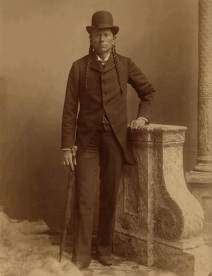
Quanah Parker in later life, as a successful businessman. Wikipedia image, public domain
- Rejecting monogamy and Christianity, Quanah founded the Native American Church movement, which regards the use of peyote as a sacrament. Quanah had been given peyote by a Ute medicine man while recovering from wounds he’d suffered in battle with U.S. troops. Among his famous teachings: The White Man goes into his church and talks about Jesus. The Indian goes into his Tipi and talks with Jesus.
- Photo at right: Quanah Parker in his later life, in his business attire. Photo thought to be in public domain.
- Bill Neeley wrote of Quanah Parker: “Not only did Quanah pass within the span of a single lifetime from a Stone Age warrior to a statesman in the age of the Industrial Revolution, but he never lost a battle to the white man and he also accepted the challenge and responsibility of leading the whole Comanche tribe on the difficult road toward their new existence.”
- Quanah Parker died on February 23, 1911. He is buried at Fort Sill Cemetery, Oklahoma, next to his mother and sister.
Quanah Parker’s epitaph reads:
Resting Here Until Day Breaks
And Shadows Fall and Darkness Disappears is
Quanah Parker Last Chief of the Comanches
Born 1852
Died Feb. 23, 1911
Other Resources:
- Photos of Quanah Parker at the Portal to Texas History
- Annual Quanah Parker Reunion in Oklahoma
- Lone Star Net entry on Quanah Parker
- Texan Cultures at the University of Texas-San Antonio
- Famous Texans.com entry
- History of the Red River War, 1874, at Texas Beyond History (University of Texas at Austin)
Spread Quanah’s story:








 Millard Fillmore's Bathtub

Cynthia Ann died about 5 years after her daughter, not a few weeks. Prairie Flower died in 1865, Cynthia in 1870. She was living with her sister and did quit eating.
LikeLiked by 1 person
Reblogged this on macressler.
LikeLike
Hi Guys my name Barbara. My roots go back to a Sallie Parker. If anyone can help, I’d love to know if Cynthia was somehow related to me. I would like to assure my kids college education as well.
LikeLike
[…] Back in June 2008 I posted this: […]
LikeLike
i love reading articles about my so many greats grandfather he had a very interesting life and even thought i never got to know him i visit his grave when i can which is hard since i live in indiana
LikeLike
Jackie, if you’re looking for enrollment in the Comanche Nation, you will find details at the tribe’s website: http://www.comanchenation.com/
You’ll probably want to read the membership rules to see whether you’re eligible, here:
http://www.comanchenation.com/enrollment/index.html
LikeLike
My Grandfather was born on the comanche reservation in the late 1800’s and I would like any info I can get to prove my American Indian heritage so my kids can recieve government help on there college education. God bless you and thank you. My grandfather’s name was Rufus Madison Lake
LikeLike
My Grandfather was born on the comanche reservation in the late 1800’s and I would like any info I can get to prove my American Indian heritage so my kids can recieve government help on there college education. God bless you and thank you
LikeLike
Gary,
Do you have any inside history you could share?
LikeLike
amanda hudson parker was married to monroe jackson parker in 1898 she was my great aunt
LikeLike
this is specifically aimed at Jeremy, but i would appreciate anyone that can help me out.
my grandmother told me that Quanah was in our family line somewhere (not sure exactly where) but i can’t get any further than my great-great grandfather whose name was Joseph Wilmer Parker, born in 1887 in the Maryland area. i know his mother was Alice Wilmer, but can’t find anything on who his father was. If anyone has any information on Quanah’s offspring, i would appreciate it.
thank you
LikeLike
I love researching Quanah Parker. He’s my great great great grandfather. It’s something I’m really proud of.
LikeLike
Cynthia Ann Parker died shortly after the census taken in Oct 1870 in Anderson Co TX. At the time, she was living with her sister Orlena and Orlena’s husband- James Rufus O’Quinn. Her daughter Toh-Tsee-Ah (“Prairie Flower”) died about 1964.
Uh-dah (Comanche for thanks)
LikeLike
[…] Quanah Parker: http://www.nativeamericans.com/QuanahParker.htm http://www.comancheindian.com/ https://timpanogos.wordpress.com/2008/06/19/historic-images-quanah-parker-last-chief-of-the-comanches… Possibly related posts: (automatically generated)Historic images: Quanah Parker, Last Chief of the […]
LikeLike
Great post. I grew up in Mexia, Texas. Fort Parker is between there and Groesbeck and I grew up fighting indians while in elementary school out there. HA! Learned a couple of things in your writing. As you get older it is amazing the things you wished you paid more attention to growing up. I look forward to learning a thing or two here. Keep it up.
LikeLike
So, where were you when I was trying to get a Texas blog carnival going?
Thanks for dropping by, Will. My son is asking me to do more history stuff, too, but I think he’s interested more in national political history. As a non-native (” . . . but I got here as soon as I could”) I don’t know the little quirks of Texas history I wish I did. But I’m working on it. Basically, if it’s not in the Texas history texts in 7th grade, I’m probably unfamiliar with it.
Father Margil?
LikeLike
I’m glad to see this posting. I’ve been composing a bibliography of “Historical and Literary Texana Blogs.” I enjoy your Bathtub and its orientation. Beyond the current struggle against TEA’s slouching toward Gomorrah, could you more occasionally post Texas history matters (maybe highpoints or lowpoints in our education history, maybe start with Indian pictographs or Father Margil) so that I could include the Tub in my bibiography? Also send cookies and warsh my car. Thanks.
Besides the Bookshelf my other blog is http://texasparlor.blogspot.com/
Will
LikeLike
Speaking of Terlingua, when’s the chili cookoff this year?
LikeLike
Makes me proud to be a Sul Ross graduate.
Ring in Terlingua
LikeLike